Sunday, August 3, 2014

Sigma Solutions for Women: Opening Up a "Non-Talker" (Introduction)

Husband not listening

Question: My husband’s not a talker. How do I get him to open up more?

Let’s start with a clarification: Is your man (a ) socially quiet or (b) emotionally quiet? Believe it or not, there’s a difference.

Background

”Social silence” is almost entirely personality based; some of us (both men and women) are naturally more introverted; that is, inwardly focused and energized by thought/analysis. In most cases, your socially quiet partner had that personality when you met him. While personality is generally considered to be an “in-born” quality, a person can learn how to overcome social discomfort or can learn how to increase their “extraversion.” In other words, a seemingly shy person can gain a higher sense of ease in social settings.

But most women who express concern about a quiet partner are actually referring to a man’s “emotional silence.”

To overcome personality-based emotional silence,  just understand what makes an “introverted” personality tick. An introvert likes to mull things over — sometimes for an extended period — before entering into a discussion, especially if the item under discussion is perceived to be important. Give him space to process his thoughts before asking questions. Remember, an introvert is more comfortable listening, especially when he agrees with what you’re saying.

Often, an extrovert mistakes her partner’s non-response as apathy or disagreement, but when pressed, an introvert will wonder what the upset is about. He thought the issue was closed. To him, no response meant there was nothing left to talk about — you did all the talking for him!

If your partner is emotionally quiet because of an introverted personality, asking for feedback or input is usually enough to get a response. And if he agrees with what you’ve said, expect a short and concise response and take it for what it is: a validation.

But what about men who, when asked what they are thinking or feeling, respond by saying, “Nothing” or “I’m just mad” — or don’t respond at all?

First, recognize the real reason you want your husband to open up to you: Security. Not knowing what your husband is thinking or how he feels can be disconcerting, especially since it’s his job to make you feel safe and secure in the first place. Most women struggle to admit they need their husband’s validation because they believe it makes them appear weak or needy. Nothing could be further from the truth.

When your protection is your husband’s number one priority, you’ll automatically feel secure and the need for validation will vanish.

So if you’re feeling insecure or feel like you’re flying solo, your man needs to better fill the Protector role. Over the next few days, I’ll discuss the different reasons for your man’s emotional silence and how you can naturally inspire him to build this Sigma behavior.

Next: Emotionally Quiet Men, Reason 2 — Avoiding conflict

—————

Dr. John Alexander is relationship expert and the author of The Sigma Male: What Women Really Want. To learn how the Sigma Roles can improve your relationship, visit his website, subscribe to his blog, “like” his page on Facebook, and follow him on Twitter.

Friday, August 1, 2014

A Husband's Essential Role

Essential definition

This week I picked up Greg McKeown’s book, Essentialism. Within a few pages I hit this passage:

Have you ever found yourself stretched too thin? Have you ever felt both overworked and underutilized? Have you ever found yourself majoring in minor activities? Do you ever feel busy but not productive? Like you’re always in motion, but never getting anywhere?

If you answered yes to any of these, the way out is the way of the Essentialist.

Truer words were never spoken, especially in the context of improving a relationship. Before the epiphany that led me to develop the Sigma Philosophy, I was struggling to please my wife with little success. As a husband I was a “non-Essentialist” —  I was trying to do everything but accomplishing nothing. While I was a good man — effectively checking off most of the “nice guy” boxes — I was not implementing the one essential thing that would make me a great husband.

McKeown goes on to better define this concept:

[This idea] can be summarized by a characteristically succinct principle, captured in just three German words: Weniger aber besser. The English translation is: Less but better. A more fitting definition of Essentialism would be hard to come by.

The way of the Essentialist is the relentless pursuit of less but better. It doesn’t mean occasionally giving a nod to the principle. It means pursuing it in a disciplined way.

When a principle is true it applies across the board, whether in academics, business or life. In this case, learning to put your energy into the most important area of “relationship-building” should result in greater yields of marital success, fulfillment, and happiness. And it does!

For every man, the essential role is Protector. As such, every thought, action and reaction will be influenced by a Protective Mindset. This simple focus — “How can I most effectively protect my wife?” — must override any other consideration. Amazingly, the more emphasis a man puts on being a Protector, the faster he will become the husband his wife desires, because he will be delivering what she most needs: Complete security.

As McKeown so aptly states:

Essentialism is not about how to get more things done; it’s about how to get the right things done. It doesn’t mean just doing less for the sake of less either. It is about making the wisest possible investment of your time and energy in order to operate at our highest point of contribution by doing only what is essential.

Become a Sigma Male — a Relationship Essentialist. Learn how to protect.

—————

Dr. John Alexander is an expert on marriage relationships and the author of The Sigma Male: What Women Really Want. To learn more about importance of the Sigma Roles in marriage, visit his website, subscribe to his blog, “like” his page on Facebook, and follow him on Twitter.

Thursday, July 31, 2014

5 Ways to Avoid Relationship "Potholes"

Happy marriage

Parade recently published an article titled Happily Ever After: The New Science Behind Wedded Bliss. I’ve summarized the article and added a few comments of my own.

1. Remember That You’re a Team

Parade says:

Avoid behavior that cause division. Thomas Bradbury, Ph.D advises couples to “remember that you’re in this together. It’s not you against each other. It’s both of you against the world.”

More than 40 years ago, relationship expert John Gottman, Ph.D. identified four negative behaviors that could predict divorce with over 90% accuracy: criticism, defensiveness, contempt (e.g. rolling your eyes), and stonewalling (a.k.a. the silent treatment). Studies show that stress is the best predictor of how negatively couples behave with each other.

The Sigma Male says:

A Protector does not attack his wife.

It is impossible to become your wife’s dragonslayer when you are one of her dragons.

When the wife of a Sigma Male experiences stress, he defends her by slaying dragons and goes on offense by maintaining a complete, protective wall.

In stark contrast, when the wife of a Modern Man experiences stress, he will interpret her response as a personal attack, making himself the victim. If he is oversensitive he will defend himself and go on offense by attacking her.

In order to protect your wife, the Sigma Mindset requires you to shed the victim mindset once and for all and develop the masculine attitude that you are tougher than she is. If your wife thinks she is tougher than you, you have a problem. 

If you are more easily wounded than your wife, she will never believe you can be strong enough to protect her. If she believes you are more sensitive than she is, you have a big problem. 

Men, make the simple choice: don’t whine as a victim. Instead, choose to protect as a Sigma. (The Sigma Male, pp. 138-139)

2. Try a Little Tenderness

Parade says:

It’s not just words that help or hurt a marriage. Couples who regularly apply a positive “affect” (the outward display of emotion) are more likely to be happy than those who can’t. For example, using a warm tone of voice versus turning away. This means that you can make up for losing your cool in other ways.

The Sigma Male says:

This is an extension of item #1. Being a Protector automatically engenders natural sensitivity and tenderness.

Men don’t need more sensitivity training. They need to learn how to reclaim their masculinity, because when a man learns true masculinity – to protect – true sensitivity emerges of its own accord. 

If you are a father, recall the first time your child was placed in your arms. Her limbs were wrapped snugly in a blanket because she did not have the strength to hold them steady on her own. Her hands, pink and wrinkled, opened and closed as she sought contact with the massive hand you offered her. She was completely vulnerable, utterly reliant on you to care for her and protect her from a cold, alien world that was apathetic to her basic needs. Your heart immediately responded. In an instant, you chose to protect her no matter the cost while marveling that anyone would even allow you to try.Once a man realizes he has a duty to protect, it becomes natural – almost easy – to selflessly accomplish this task. (The Sigma Male, p. 157)

3. Soften Conflict with Humor

Parade says:

Laughter can go a long way toward defusing tension during negative interactions, according to Sarah Holley, Ph.D., director of the Relationships, Emotion, and Health Lab at San Francisco State University. A light moment can keep an argument from spiraling out of control.

The Sigma Male says:

Both men and women list humor as one of the top 10 characteristics looked for in finding a mate. But humor can only be used effectively when you are in control of your emotions. Otherwise, a quip will come across as being sharp or laced with sarcasm. Initially showing a degree of stoicism — the ability to appear unfazed when others around you are losing their cool — is essential. When you’re calm and collected a funny statement can give others a way to cope with a stress-filled moment. It has the same effect as dropping a gag in the middle of a horror flick: temporary relief of tension.

4. Support — But Don’t Smother

Parade says:

“Social support” is vital to marriage happiness. University of Iowa psychologist Erika ­Lawrence has identified four kinds of support: emotional (listening, holding hands), tangible (dealing with the kids or helping with a ­partner’s chores), esteem (“Honey, I know you can do this!”), and informational (giving ­advice). The trick is knowing which your spouse wants.

Experts suggest couples need to ask for the type of response they require.

The Sigma Male says:

Having a spouse tell you what they actually need is great — it just doesn’t happen that often. This is why dragonslaying requires two skillets: identification and action. Men tend to jump to the action stage before they know what the problem really is, which causes that anger and resentment attached to “giving advice.”

Empathetic listening is an important skill to develop in actually identifying the cause of your spouse’s stress. Mirroring back what you hear is a good way to know if you have correctly identified the issue. After this, agreeing with the pain connected to the stress is essential (showing empathy).

Once your partner knows you recognize the problem, offer to take care of it. Most of the time the fact that you understand and empathize will be enough and no action will be required. However, when your spouse accepts an offer of help, act quickly and decisively.

5. Celebrate Each Other

Knowing your spouse will be there for you when things go bad lays a strong foundation for a happy marriage. Experts say this belief is developed from how you react when good things happen. For example, do you respond actively or passively, constructively or destructively? In the case of a promotion, saying, “I know you’ve worked hard for this” is active/constructive versus saying,” Wow, do you really think you can handle this extra responsibility?” (passive/destructive)

The Sigma Male says:

This is great advice that should be practiced in every relationship. However, experience shows that being supportive during a crisis carries much more weight than celebrating a success. When a man falls prey to unleashing a rant during a crisis, all the nice things said during better times get thrown out the window.

Protective behavior requires consistency: being positive during the good and the bad.

This does not mean mistakes will not be made. But when your focus is on being a Protector, recognizing you’re headed down an angry path is much easier. That’s when a quick apology will get things immediately back on track. When you realize you’re being negative, the time to apologize is now. Don’t waste energy “stonewalling.” (see #1).

—————

Dr. John Alexander is an expert on marriage relationships and the author of The Sigma Male: What Women Really Want. To learn more about importance of the Sigma Roles in marriage, visit his website, subscribe to his blog, “like” his page on Facebook, and follow him on Twitter.

Wednesday, July 23, 2014

Husband Tracks Wife's 'Excuses' For No Sex

Do men keep track of how long it’s been since they last had sex? You better believe it. Witness the Reddit post by a women whose husband emailed her a spreadsheet listing the results of 7 weeks of requests for sex (only 3 “wins” in 28 days):

Sex spreadsheet

The email arrived in her work email inbox. In addition to the attached spreadsheet, he also had the “courtesy” to let her know he wouldn’t be missing her during her upcoming ten day business trip. Within days the posted spreadsheet image was removed and the post was locked, but not before it garnered 755 comments and went viral.

Where do I begin?

I’ve commented on the troubling trend of humiliating a spouse here.

I’ve commented on men complaining about a lack of sex in their marriages here, here and here.

I’ve commented on men complaining about their wives focusing too much on work here.

How about this? Perhaps most amazing is the lack of insight found in the litany of comments left on Reddit and other sites that re-ran the story. Most focused on the standard red herrings: poor communication; asking for sex without any romantic overtures; changes in the relationship due to time, children, work, and stress; the nature decline of sex in a marriage; a wife’s obligation to give her husband sex; and so on.

NOT ONE commenter dialed in on the true problem in this marriage: Gender Role Reversal stemming from a failure in one or more of the three Sigma Roles: Protector, Provider, Presider.

One thing is certain: Sex is always a barometer for what is happening outside of the bedroom. If a woman doesn’t respect a man outside the bedroom, she certainly won’t respect him inside the bedroom.

Let’s cut to the chase. Here is a simple, three-line translation of the spreadsheet’s contents:

Husband: Let’s have sex.

Wife: I don’t desire you. Let me make up an excuse.

Husband: I will try again tomorrow night. In the meantime, I will pout.

Let me be clear: There is little worse for a man than to be rejected by his wife — I know from personal experience — but consider how sad it is for a woman to be so repulsed by her husband that she has to come up with a nightly excuse to avoid physical intimacy. I guarantee that when this woman says she feels “sweaty and gross” she is projecting how she knows she will feel if she were to submit to her husband’s request. After all, she would rather go to bed smelling like a rank gym sock than to risk having him follow her into in the shower or to have to make up another excuse after her shower.

Sadly, every so often she gives in — partially submits — to placate him or perhaps to reward him for something nice he’s done, but obviously nothing changes. Without a doubt the experience is unfulfilling for her — and most likely downright degrading.

Here’s the key to understanding sex in a relationship:

For a woman, the security of feeling completely loved and protected leads to the desire for sex.

At its best, intimacy in marriage builds a rock-solid bond of loyalty and love; at its worst it becomes a source of frustration and obligation — a real power struggle.

The bottom line?

Positive, dominant behavior is always the solutions to eliminating sexual frustration and achieving true intimacy

Changing your focus from your wife’s inattentiveness and low libido to increasing your positive, dominant behavior (Protecting, Providing, Presiding) is a strategy that will always increase the intimacy in your marriage.

Men, the power and responsibility to make this change is in your hands. (The Sigma Male: What Women Really Want, pp. 127, 129, 132)

 If a man wants his wife to be in the mood to have sex — to allow herself to be vulnerable without reservations — he must first help her feel completely safe and secure in their daily interactions.

—————

Dr. John Alexander is an expert on marriage relationships and the author of The Sigma Male: What Women Really Want. To learn more about importance of the Sigma Roles in marriage, visit his website, subscribe to his blog, “like” his page on Facebook, and follow him on Twitter.


Tuesday, July 22, 2014

Different Approach or Poor Performance?

In a post titled “3 Simple Ways Women Can Strengthen Their Relationships,” I led with this recommendation:

 1. Thank him for completing a task, even when he doesn’t do it the way you’d like it to be done

The example I used (loading a dishwasher) prompted a reader to forward me this graphic (courtesy of The Oatmeal):

How to Load a Dishwasher

I admit this comic gave me a good laugh, but even better were the tongue-in-cheek comments posted on Facebook. Some of my favorites include:

  • NO ONE loses chores based on poor performance in this house. No. One.
  • Step Six: Run Dishwasher again…
  • Step Six: Act surprised when husband/wife divorces you for being a lazy ass and takes all your money 

Another commenter posted this follow-up image:

Bad job

…to which a witty female replied:

That includes sex.

Apparently, dishwasher-loading is rattling a few cages, as evidenced by this comment:

My dad literally took my sister and me aside when we were kids and dispensed this “wisdom” to us. Not specifically about dishes, but any task you don’t want to do. “#&!@ it up,” he said, “and keep #&!@ing it up no matter how many times they show you how to do it right. Eventually they'll give up and then you won't have to do it any more. You don't see me washing dishes, do you? That’s because I kept washing them in cold water until your mother finally gave up." 40 years later my dad is now facing living out his twilight years alone, after having wrecked two marriages via apathy and neglect. So yeah, this cartoon is great advice if you wanna steep in your own dirty Depends when you're in your 80's. Just sayin’.

Another viewer offered this advice:

Here’s the solution to a spouse/roommate/whatever who does a $#^& job to get out of it in the future: Instead of falling into the “oh #&!@ it, I’ll do it myself” trap, do this: Male the person do it over WHILE YOU STAND OVER THEM. Until they get it right. DO NOT DO ANY OF IT FOR THEM. Give “advice" the entire time. Then they learn if they do it right the first time, they won't have to it over. Yeah it sounds bitchy, but people need to do their share. Don't be a doormat.

Ouch!

All of this got me thinking. What are other examples of performing poorly to avoid household responsibilities?

  • Pretending to be asleep when the baby cries in the middle of the night so your spouse will have to get up
  • Leaving crumbs in a cereal box or a splash of milk in a carton
  • Mashing additional items into an already-full trash bag to avoid taking it out
  • Letting the phone ring so someone else will have to pick it up
  • Watching TV next to a hamper full of unfolded laundry

What would you add to this list?

There is a definite distinction between having different standards about “how a task ought to be done” versus purposely screwing up to avoid responsibility. But the truth is, when it comes to ascertaining our partner’s motives and intents, we can seldom tell the difference — and we usually assume the worst.

Part of Sigma Coaching requires a person to identify their own motives and biases, and then take responsibility for each accompanying negative reaction and response. After all, you cannot control the motives, biases, reactions, or responses of your spouse! But you can have total control over your own, and that is the first step in wielding influence with your spouse.

Because men and women tend to have distinct views of the world as well as different approaches to problem solving, the steps to gaining control of a reaction and response work better when they are custom-tailored to each spouse. But the starting point is the same. Ask yourself these questions:

  • Do I screw-up on purpose, either to avoid responsibility or to “teach my spouse a lesson”? 
  • Do I assume my spouse screws up on purpose because they do something differently than I do? 

Remember, only you have the power to load a dishwasher to the best of your ability — and the humility to believe that your spouse is doing the same.

—————

 Dr. John Alexander is an expert on marriage relationships and the author of The Sigma Male: What Women Really Want. To learn more about importance of the Sigma Roles in marriage, visit his website, subscribe to his blog, “like” his page on Facebook, and follow him on Twitter.


Monday, July 21, 2014

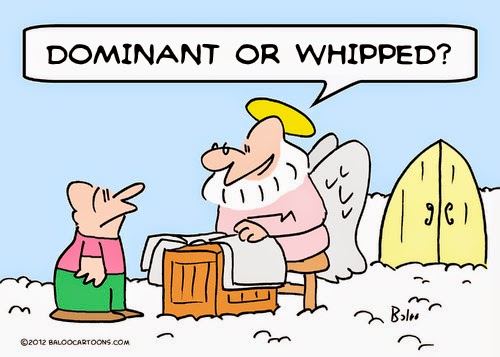
Form two lines: Dominant men on one side, whipped on the other...

Heaven saint peter dominant whipped

After the Apocalypse everyone on earth dies and goes to heaven. God appears to the crowd and says, "Men, sort yourselves into two lines: Stand in line one if you dominated your woman on earth. Stand in line two if you were whipped by your woman. Women, follow  St Peter.”

Said and done.

God looks out over the crowd. The women have left and there are two lines. The line of whipped men is thousands of miles long. The line of dominant men has a single, solitary soul.

God’s wrath is kindled. He thunders, "You men should be ashamed of yourselves! I created you in my image yet you were all whipped by your mates. Only one stood up and made me proud. Look to him for wisdom!”

God turns to the lone soul and says: Tell them my son. What actions did you take on Earth that brought you to stand in that line? 

The man replies, "Beats me. My wife told me to stand here!”

Where would you stand? 

—————

 Dr. John Alexander is an expert on marriage relationships and the author of The Sigma Male: What Women Really Want. To learn more about importance of the Sigma Roles in marriage, visit his website, subscribe to his blog, “like” his page on Facebook, and follow him on Twitter.